I have seen teams run beautiful retrospectives for six months straight and still revert to the old way the moment pressure arrived. The process was installed. The change was not.
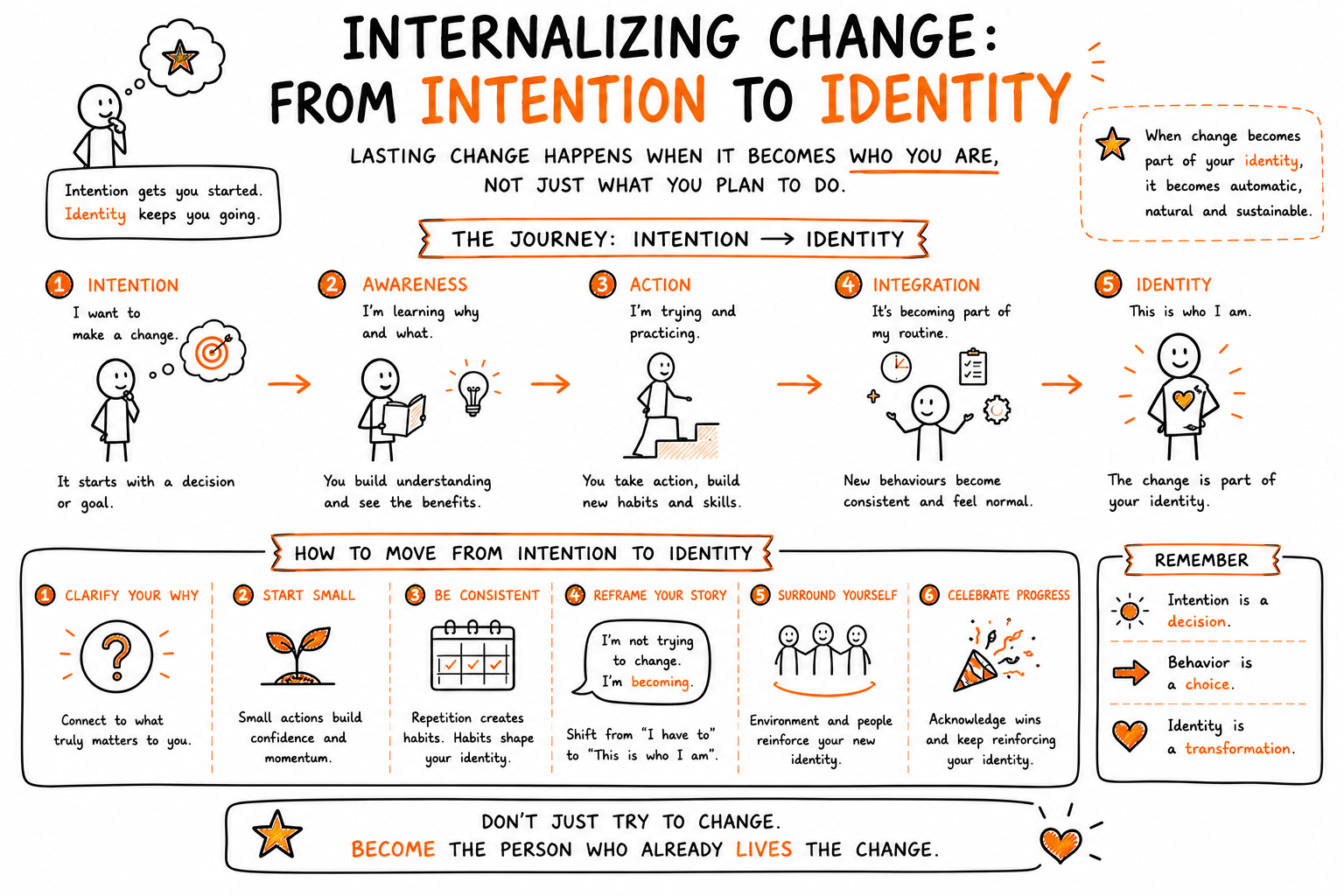
There is a six-stage path that describes how any real change takes root in an individual or a team. Understanding it changed how I coach.
1. Intention — The starting point. The team has decided they want to work differently. This is the stage where most coaching initiatives begin and end. It feels like progress because something was decided. It is not yet change.
2. Behavior — Action follows intention when the environment supports it. Ceremonies are adopted. Tools are configured. The behavior is visible but effortful. People are doing the new thing while still thinking in the old way.
3. Habit — Repetition begins to reduce friction. The standup no longer needs to be scheduled. The retrospective is already in the calendar. The team stops debating whether to do it.
4. Practice — Habit becomes craft. The team is not just doing the ritual; they are getting better at it. Retrospectives surface real issues. Planning produces realistic commitments. This is where delivery health actually improves.
5. Second Nature — The way of working is no longer thought about. It is simply how the team operates. New members are onboarded into it without formal training.
6. Who You Are — The final stage. The team's identity has absorbed the change. They do not do agile. They are agile. This is the difference between a team that has followed a framework and a team that would defend a principle under pressure.
Most coaching engagements end at stage two or three. The consultant leaves, the ceremonies continue for a while, and then pressure collapses them back to baseline.
The work of a good coach is not to install behaviors. It is to accelerate the team from intention through to practice, and to design the conditions that allow second nature to form even after the coach is gone.
That means building team norms, not just team rituals. It means coaching the leaders, not just the practitioners. And it means measuring the right things: not whether the standup happened, but whether the conversation in the standup changed.
Agile & Operations Consultant
Two decades driving transformations, scaling teams, and streamlining operations for leading organisations.
About Me