Change can be negative or positive, intended or unexpected. What makes it hard is not the change itself. It is the human brain's response to it.
Humans are hard-wired to resist change because change reads as risk and the brain is built to seek safety. But humans are also hard-wired to embrace change when they choose it, when it aligns with growth, when it promises something better.
Change models exist to help us navigate the gap between those two states.
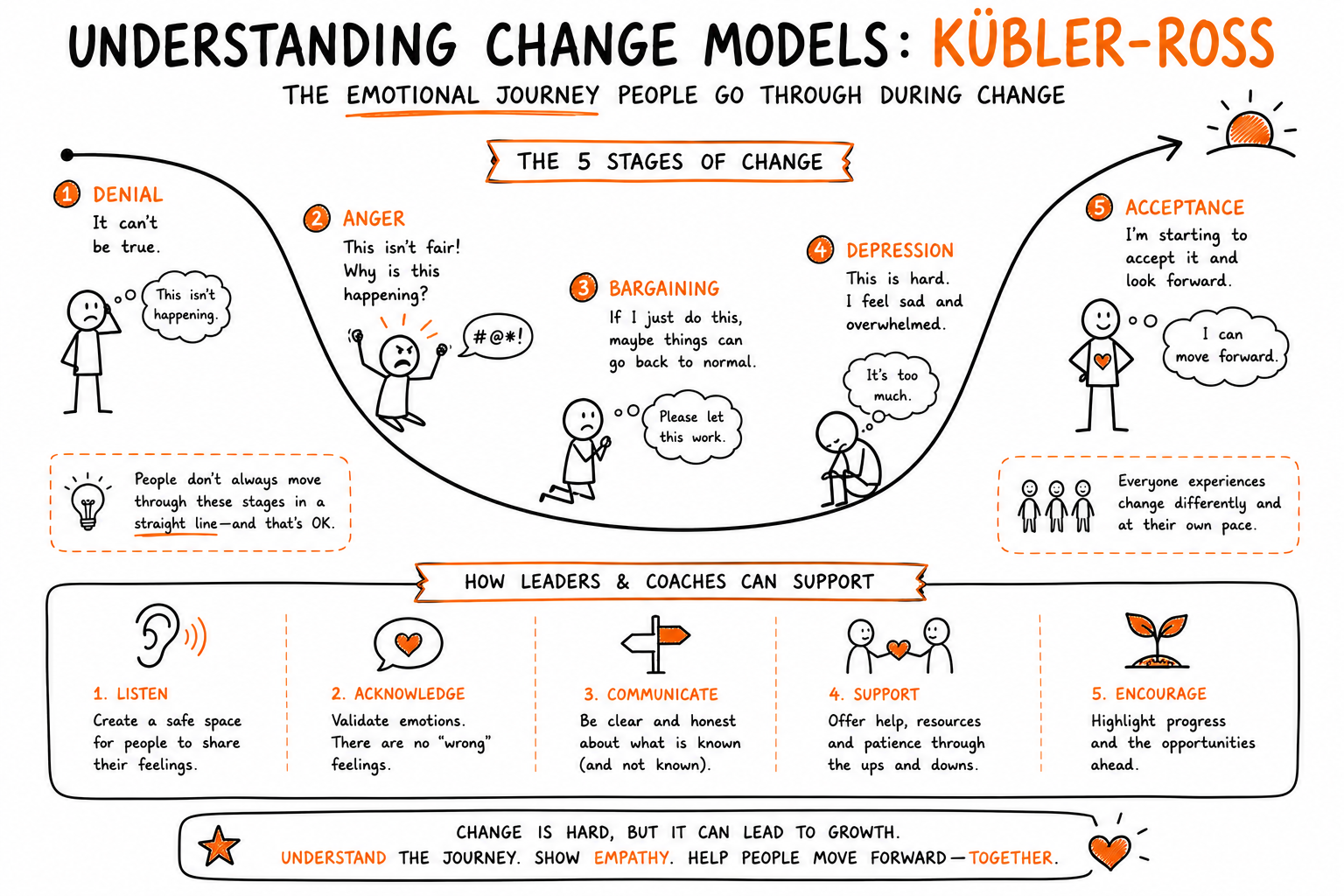
Originally developed to describe grief, the Kübler-Ross curve was adapted for organisational change management and remains one of the most useful diagnostic tools I carry.
The curve describes the typical emotional journey through change: shock and denial at the start, frustration and depression in the middle, followed by experimentation, decision, and integration as the change takes hold.
The most important insight from this model is not the curve itself. It is that change is perceived as either negative or threatening even when it is objectively positive. Leadership teams often underestimate how threatening their good news sounds to people in the middle of the curve.
Developed by Prochaska and DiClemente and frequently used by health coaches, this model maps behavioural readiness through five stages:
The value of this model is the instruction it gives on approach. You cannot use the same intervention for someone in Precontemplation as for someone in Preparation.
For Precontemplation: expose them to new information without pressure. Plant seeds.
For Contemplation: help them weigh up the pros and cons. Make the case clearly.
For Preparation: help them make a concrete plan. Remove ambiguity.
For Action: reduce friction and celebrate progress.
For Maintenance: build structural reinforcement and peer accountability.
As a coach, my first job in any engagement is to identify which stage each stakeholder is at. From there, I can sequence my approach rather than applying the same message to everyone and wondering why half the room goes cold.
Change readiness is not a toggle. It is a spectrum. Meet people where they are.
Agile & Operations Consultant
Two decades driving transformations, scaling teams, and streamlining operations for leading organisations.
About Me